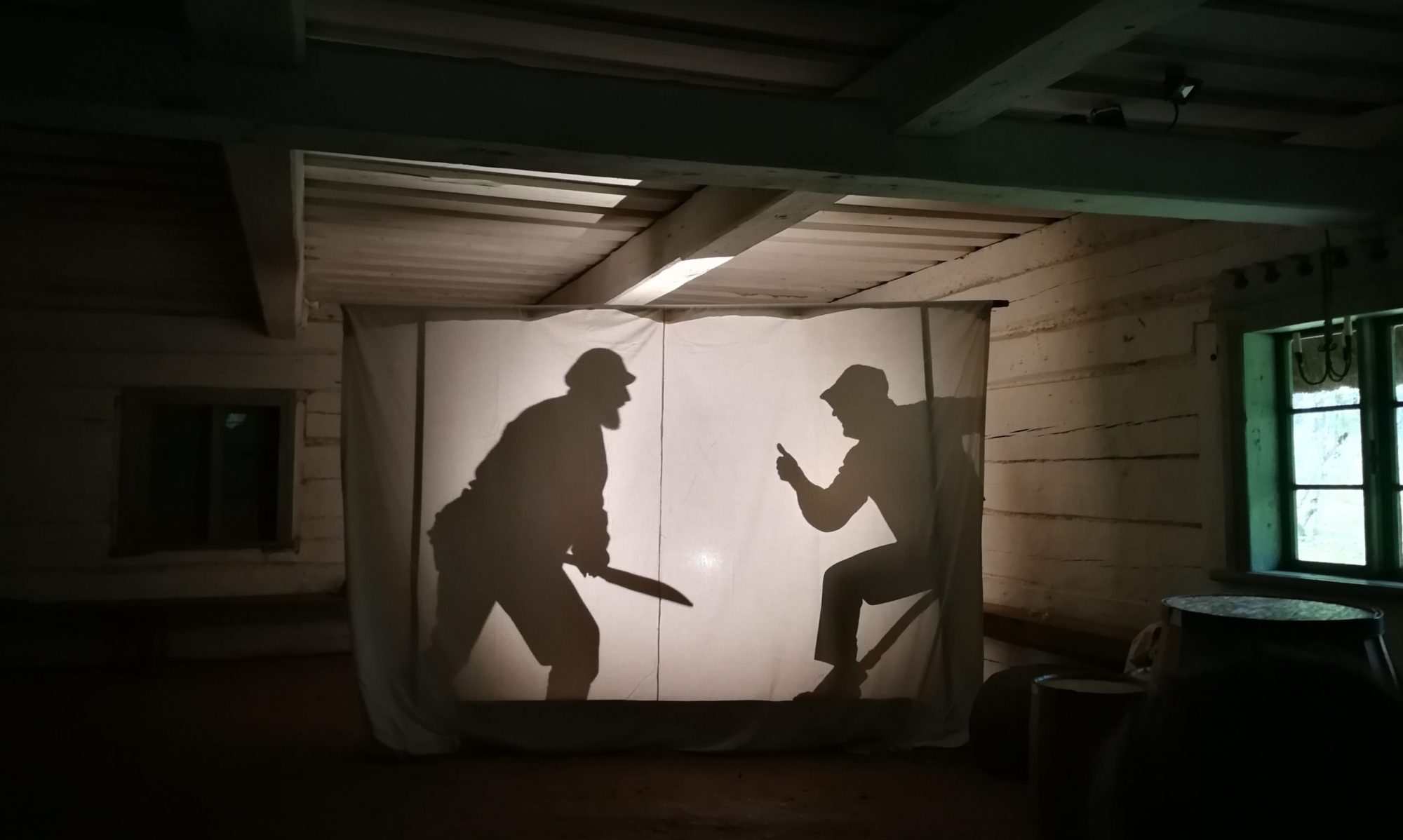
“Threesome” (2020)
Author: Egils Snore.
Length: 6 scenes.
Genre: chamber drama in 6 scenes.
Cast size:1 woman and 2 men.
Set: apartment.
Synopsis: a couple (a man and a woman) in their forties have comparatively
recently met and have started living together in her apartment. Yet there is
also a man (in his sixties) in the apartment who sometimes appears and
occasionally vanishes, and more or less actively interferes in the couple’s life. A fight of relationships begins
that hasan unexpected outcome.
Awards: the play was one of 12 selected for the Latvian Play Anthology (published planned in 2021).
Rights: managed by author – egilssnore@inbox.lv
Translations available:
not translated yet.
„Eda’s Moment of Triumph” (2021)
Author: Lelde Stumbre.
Length: 16 pages.
Genre: drama
Audience: adults of all ages.
Cast size: Leo – a young man, 20 years old, unfriendly, self-confident, but ready to listen.
Eda – woman, 75 years old, friendly.
Set: Eda’s apartment.
Theme: understanding.
Synopsis: by coincidence, 75-year-old Eda meets 20-year-old Leo and the two are forced to spend several hours together. The beginning of their meeting is uneasy, as Leo has other, more interesting things to do. However, as the time passes, they begin to understand and it turns out – it is neither impossible, nor even that difficult.
Awards: the play was one of 12 selected for the Latvian Play Anthology (published in 2021).
Rights: Lelde Stumbre, lelde.stumbre@gmail.com. The author requests you to inform her of any performances.
Translations available:
not translated yet.
“Mothers and Fathers day” (2021)
Author:
Kristiāna Štrāle Dreika.
Lenght:16
pages.
Genre:family drama.
Audience:adults.
Cast size: 2 male, 2 femaleroles.
Set:two small adjacent apartments.
Theme: nowadays more and more people want to live by themselves, and this play gives insight into lives of two of them.
Synopsis: Daina is kind-hearted woman, who has chosen to live alone. One day she comes upon unexpected guest in her flat – young man who claims that he is Andrejs- the same boy Daina had taken from orphanage 9 years ago but later took him back due to his bad behavior. After few days Andrejs visits her again, meanwhile Daina has found out that Andrejs actually is another man who escaped from the prison. Fake Andrejs confesses that he has been imprisoned for the murder of real Andrejs, but isn’t guilty – Andrejs has actually committed suicide exactly in Mothers day because he had been depressed for the fact that Daina left him.
Aigars also lives alone in the next door apartment. He likes independence, challenges, extreme competitions and adventures. He doesn’t want to have any children and long term relationship with any woman. His current profession is debt collector but then he founds out that he also is “in debt”… Unexpectedly Maira visits him –young woman in a wheelchair and she has financial problems. Aigars was sure that he has no children, but it turns out that Maira is his daughter.
Awards: the play was one of 12 selected for the Latvian Play Anthology (published 2021).
Translations available:
not translated yet.
Rights:
managed by author – please email kkrrii@inbox.lv.
“Flowery Swimsuit” (2015)
Author: Biruta Zujane.
Length: 26 pages.
Genre: drama.
Audience: adults and young adults.
Cast size: 2 men and 2 women plus the voice of a radio announcer.
Set: countryside.
Theme: only old people remain in the countryside and the link between generations is broken. Betrayal.
Synopsis: there are two abandoned villages along the shore of a lake located deep in the countryside where only three elderly people, aged 76-80, remain.
Rosalie lives on one shore, alone in her house with
the old apple orchard that is a precious memento of her dead husband, and a
goat given to her by her neighbour Dusja. However the title to the house has
already been transferred to her grandson.
On the other side of the lake lives Dusja, a retired
veterinarian.
In the forest between the two villages lives Juoņs, who is haunted by a traumatic experience when
he was a boy during WWII and lost a Jewish friend.
The three of them stick together. They listen to the
radio, which is broadcasting a new humorous story about the misfortunes of
townspeople.
Grandson Gust, 25, grew up in the country with his
grandmother Rosalie, but later moved to the city with his mother for better
educational and work opportunities. After many years, Gust has finally returned
to the countryside and tries his best to persuade his grandmother to move to
the city, but why?
Awards: encouragement
prize, Latvian National Theatre 2016 play contest. The play was one of 10
selected for the Latvian Play Anthology published in 2020.
Translations
available: Russian.
Rights:managed by author as well as AKKA/LAA (https://www.akka-laa.lv/lv/ ). The author requests you inform her of any
performances at biruta.zujane@gmail.com
“To stay human” (2014)
Author: Inese Talmane.
Length:2 acts, 41 pages.
Genre: drama.
Audience: young adults, adults.
Cast size: 8 male and 5 female roles.
Set: prison cell, meeting room, another room at prison.
Theme: to stay a human in all circumstances.
Synopsis: Edmunds goes to prison for a misunderstanding. He learns about prison conditions, the order prevailing there and prison cell members. Edmunds was hurt by one of cell members, but when he was recovering, he got to know, that he was justified and could go to his family.
Awards: best play
staged by Latvian amateur theatres
in 2018.
Rights: managed by author – inese.talmane@inbox.lv
Translations available: not yet.
“Look for a woman” (2020)
Author: Anna Rancane.
Length: 10 pages.
Genre: tragicomedy.
Audience: adults.
Theme: grotesque
message about human relationships, about loneliness and the power of an
artist’s talent, about daring and faith in a miracle that can change the world.
Synopsis: the
main character – an ordinary man, security guard at a
provincial town art museum . In the museum he meets an unusual woman who
makes him to look at his life from a completely different perspective. This
woman can be an all-in-one question just whether we are able to believe and
indulge in a miracle.
“You can’t believe it and sit here as much as you like! But you
can choose what to do for you. You can slaughter chickens and put out nightingales,
you can write a poem about your favorite painting.”
Awards: the play
was one of 10 selected for the Latvian Play Anthology published in 2020.
Rights: please contact – anna.rancane@gmail.com
Translations
available: Lithuanian.
“Friends” (2021)
Author: Inese Talmane.
Length: 1 act, 34 pages.
Genre: relationship drama.
Audience: young adults.
Cast size: 1 male and 1 female roles.
Set: living rooms of both participants
Theme: the fragile line between friendship and love
Synopsis: Alise and Felikss are the best
friends from childhood. Sometimes each of them feels like in love, but both
afraid take the first step. If the
other doesn’t feel the same? They are afraid of not getting a loved one and
losing a friend. What to do if another appears in a friend ‘s life?
Awards: the play was one of 12 selected for the Latvian Play Anthology – published in 2021.
Rights: managed by author – inese.talmane@inbox.lv
Translations available: not yet.
„The Trip From Liepaja to Embute” (2015)
Author: Rodžers deKūrs/RogerdeCour (penname,
originally – Ivars Ozolins)
Lenght: 40 pages.
Genre: nearly mono play, roadplay, comedy.
Audience: 12+
Cast size: 1 female onstage, 5 female and 6 male voices
(less, if experienced team)
Set: car and
surroundings of the car.
Theme: family relations, business adventures.
Synopsis: the lady
who is hardened by life goes on anunexpected busines strip to Embūte. In a
bunch of adventures, she suddenly has the opportunity to fulfill her dream of
being on a private island in Greece. The question is one – will she use the
greatest opportunity of her life or go to the rescue of her troubled,
unfaithful husband?
Awards: the play
was one of 10 selected for the Latvian Play Anthology published in 2020. It was
also selected for the play workshop „36 hours” in 2014.
Rights: managed by author – please email roger.de.cour@gmail.com
The author requests you inform about any performances.
Translations available:not
yet.
„Say Good Or Say Nothing” (2020)
Author: Elizabete Hafere.
Lenght: 16 pages.
Genre: detective comedy with a tragic note.
Audience: adults.
Cast size: 1 male and 9 female roles.
Set: kitchen.
Theme: intrigues and relationships in the work team.
Synopsis: after the funeral of Viola Ziemele, the editor of the newspaper, the team gathered in the editorial staff’s kitchen. Employees are relieved and do not mourn the loss of the editor who had been bossy, arrogant and conceited woman. The team raises toasts for the upcoming new editor. Then Ziemele’s goddaughter Laila Bluma comes to talk about her godmother. Doctors have detected alcohol and strong drugs in Ziemele’s blood, and therefore it is assumed that her death could be a suicide. Perhaps the editor’s death is a murder? Laila talks to employees to find out the truth. Finally she concludes that her godmother had taken medication and had forgotten about it, so her death was an accident. After Laila leaves during conversation of two employees the circumstances of Ziemele’s death are revealed — Ilze added a double dose of strong sedatives to the editor’s coffee following Lazda’s advice, but Jekabsone too also added sedatives to the editor’s lemon water. When Ziemele drank alcohol in the evening, an unexpected reaction occurred in her body. They decide to say only good things about Ziemele or nothing at all.
Awards: the play was one of 12 selected for the Latvian Play Anthology – published in 2021.
Translations
available: not translated yet.
Rights: managed by AKKA/LAA. The author requests you inform her of any performances at elizabete.hafere@gmail.com
“Our Kitchen” (2015)
Author: Arta Dzīle.
Lenght: 3 scenes, 28 pages.
Genre: family drama.
Cast: Mother, Father, two adult daughters, two kids.
Set: a home kitchen.
Synopsis: the Mother and the Father are getting ready to welcome their daughter and her kids visiting from England. The Father, being a patriot of his country is concerned if their grandkids understand their native language. The Mother tends to smooth over the disputes. The secrets of each of the daughters are revealed.
What happens to the succession of generations in the families when children leave their homeland and blend with other nations? What happens to inheritance of the traditions and values? Will families be able to stay connected? Every family, every home, every society have their secrets and their “kitchen” or their “backstage”. A kitchen where everything happens – disputes, confessions, search for both warmth and togetherness. What’s hidden in our kitchen? What kind of memories and dreams are kept there?
Awards: in 2015, the play won in the play contest of Latvijas Radio (Latvian Radio.)
Translations available: Russian.
Rights: the author has a contract with AKKA/LAA. Please contact the author via email arta.dz@inbox.lv
Play “The Hunt” (2021)
“The play is literally a cry. A cry of birds, of people, of the whole world, as a desperate protest against a global humanitarian catastrophe. At a time when violence and instinct-driven cruelty, when destroying one another has become the norm, when unchecked streams of refugees are one of the greatest current challenges facing countries, when natural resources are being destroyed on a massive scale, it is time to stop and find a solution by acting, because there is no time to think,” (theater critic Erika Zirne)
“Although the play is an ecological play, it speaks both about relationships between children and adults and the modern-day problem of addiction. The story is a fantasy about the emergence of hatred that destroys the soul. An anatomy of the emergence of extremism,” (theater teacher and director, Vilnis Rullis)
Author: Biruta Zujāne
Genre: dramatic parable.
Length: one act, 11 pages.
Roles: 7 bird roles, 4 female roles and a chorus.
Theme: the play explores a situation where your actions can cause someone else’s death, but it is justified and even logically justified as a protest against a global humanitarian catastrophe.
Plot: mother Seagull flies to a landfill, leaving her children in the nest. Mother Seagull does not return. The children decide to avenge their mother’s disappearance and help their friend Em, who has lost his girlfriend.
Setting: Lakeside.
Awards: The play was one of 12 selected for the Latvian Play Anthology published in 2021.
Translations available: English.
Author’s e-mail: biruta.zujane@gmail.com The author is a member of the rights association AKKA/LAA.
“Windegg” (2016)
Author: Inese Talmane.
Lenght: 2 acts, 42 pages.
Genre: family drama
Audience: young adults, adults.
Cast size: 2 male and 5 female roles.
Set: living room, bedroom
Theme: lack of maternal love, stepfather’s entry into
the family.
Synopsis: 15 years old Lina lives with
her mother, who loves to drink. She does not know her father. Mother married a man, who, as it turns out, was later
convicted of seducing several minors into adultery. Lina also suffers from her
stepfather’s actions. The girl is believed and helped by strangers, not the
carnal mother.
Rights: managed by author – please
email inese.talmane@inbox.lv
Translations available: not translated yet.
Play “The Goldfish” (2018)
Author: Biruta Zujāne.
Genres: drama.
Length: single scene, 14 pages.
Audience: adults
Roles: four (two women, two men), plus a voice
Theme: Man and the moment. Love and contempt. Dreams and reality.
Plot: following a theater performance, a woman rides in a subway car with homeless people…
Setting: subway car, present day.
Style/direction: realism.
Theatrical type: drama, radio play.
Translations available: English.
Author’s e-mail: biruta.zujane@gmail.com. The author is a member of the rights association AKKA/LAA.
“Detective. Russian roulette” (2016)
Author: Egils Snore.
Cast size:3 female and 1 male characters.
Synopsis: a popular, even famous author of detective novels meets his divorced
wife and adult daughter after a lengthy period of time in his own house that he
had visited since long time ago. His
partly paralysed mother-in-law takes partin the meeting as well. Each of the
characters have their own interests and they struggle to achieve them. On the
basis of financial and emotional reasons the wife would like to renew the
relationships. The husband, identifying himself with the detective’s
roleattempts to get a confession about witchcraft activities. The mother-in-law
wants to eliminate her son-in-law.
Before his marriage
and during the marriage the writer had been quite obsessed with both writing
detective novels and sex. While his former wife together with her mother had
taken big efforts in order to take
possession of him.The big efforts included black magic rituals and
witches’herbs. While their daughter growing up under such circumstances has
become imbalanced. She has an inner struggle between idolizing and denying her
father. The dream of little girls to
marry their own fatheris grotesquely exaggerated. The meeting of the
foursome after many years ends tragically. (The author of the play is not
content with the present edition of the play and would like to rewrite it.
Doing it together with a stage director the result could be more productive.)
Rights: managed by author – egilssnore@inbox.lv
Translations available: not translated yet.
“Pour Some Milk for the Cat“(2016)
Author: Biruta Zujāne.
Genre: drama
Length: 4 scenes with prologue and epilogue, 28 pages
Cast size: three (1 woman, 2 men)
Themes: Is what you do necessary for others, for your children? What does it mean to forgive? To give everything to someone else without expecting thanks for it? To love and understand your neighbor? What is home – not the building – but deep in your soul. Can that sense of home be our salvation from loneliness and the fulfillment of happiness?
Synopsis: In a small town, parents Zenta and Ben are waiting for their daughter Adele, a doctor, to arrive to celebrate her birthday. But Adele does not come. Instead, she has sent a letter saying that she has gone to work as a volunteer in a conflict zone. Both parents fear for her life, but Ben finds it particularly difficult to accept, and is consumed by anger that Adele has gone secretly and is “spitting” on her parents. “Even if she comes and begs, I will not forgive her. I won’t.” But this is not the only blow that awaits Ben. His company downsizes and Ben is made redundant. He is devastated. He decides to commit suicide. Sasha, a neighbor who helps them with farm chores, talks him out of it: Do what you’re told: drink! Am I going to have to pour it down your throat?!?… Now, tell me honestly, Benedict, do you want to die?
Ben: I don’t know.
Sasha: (Pointing to his head) Benedict, stop using this rusted old pot! (Taps his chest) What does this place say to you? Tell me, what does it say?!?
Ben: (Beats his chest). This place doesn’t want to die.
Ben tells Sasha his idea, hatched in solitude, to build a house with yellow walls, his daughter Adele’s favorite color. “You see, this is a house, but it’s not a house. Because… a house should be good… but here something is missing…”
Ben doesn’t have the money to build a house, but Sasha has an idea.
Life returns to its normal routine, until Zenta learns from Sasha about Ben losing his job and that he has been hiding unread letters from his daughter abroad. Ben does not deny it, and asks Sasha to read the letters sent by Adele. They tell of work without rest, sleepless nights, sweat and blood all around, a story of a love that has no future… In her last letter, Adele reveals that she is coming back, only that she won’t be alone….
Ben feels faint and he asks Zenta: “I’ve got a cat in there… would you pour him some milk.“
Language: Latvian.
Author’s e-mail: biruta.zujane@gmail.com The author is a member of the rights association AKKA/LAA
“Waiting For Survivor”(2010)
Author: Kārlis Anitens (Translated from original, titled “Norma”, (in Latvian) 2010, translator A.Uzulena), facebook.com/karlisanitens.
Length: 39 pages.
Genre: drama.
Audience:adults.
Cast size: 3 male, 3 female roles.
Set: airport.
Synopsis: what it should be:
living or surviving? Writer Vit Reno has grown up an orphan, which is the
reason this dilemma arises before his encounter with his suddenly found mother;
seriously ill airline super star Norma is torn between the same alternatives
not being able to forget the love of her life; seemingly confident Henry –
saving his reputation, Wolbert – living his entire life in wife’s shadow, Lydia
– haunted by a single irreparable mistake of the past. It is only for Cora that
the answer to every problem lies in money.
These characters find themselves in airport, on their way to
Paris where a decades-long conflict awaits solving. Its chief subject is Norma
and Henry’s “illegitimate” child, Vit, who, protected by others’ oblivion
regarding his familial identity, gets into the center of heated existential
wonderings. The question of Living versus surviving is put to dramatic test
with people in the play getting personal. Three characters board the ill-fated
airplane heading to catastrophe soon after the take-off. One of them will
survive. The question, of course, is – who? Waiting to find it out, those left
on the land ask themselves whether this turn of events will let them live or
just to survive in the world that has turned honesty to oneself and to the others
into a There-was-once-upon-a-time myth. When the catastrophe survivor arrives,
the question has to remain unanswered for his miracle escape from death is but
a chance to avoid confronting the truthfulness issue once again.
Who of the play’s characters to sympathize with, the author
leaves for the reader or the viewer to decide as there are no good and bad ones
in this tale; just the living human being with his longing for life’s
fulfillment and his sometimes relentless reality…
Translations available:English.
Rights: for full information about rights and full text of play please
contact: karlisanitens@gmail.com.
“Power makes perfect” (2009)
Author: Kārlis Anitens
(facebook.com/karlisanitens).
Length: one act, 16
pages.
Genre: tragicomedy.
Audience:adults.
Cast size:
2 male and 1 female roles.
Set:funeral service.
Synopsis:the events of the play encompass the time as far back as the period it took for the USSR to crumble and touch upon the present focusing the spotlight on a small funeral service, which grounds its success in some water-tight cooperation with the top echelons of power. Disturber of the operation’s peace Mister X’s expensive offer not to be refused is to neutralize its locomotive in the Government. The funereal business professionals are unfazed by the tricky situation and masquerading as innocent old-timers they manage to prevent an attack on their Minister as well as counteract to Mystery man who turns out to be an ambitious investigator with his eye on hitting a high-ranking post in the public sector. But there is still space for drama on the way to finale: the old couple are not without far-reaching plans themselves and, taking the lead from Mister X, they get rid of their man in Government to have a taste of governing themselves.
Translations available:English.
Rights:for full information about rights and full text of play please
contact: karlisanitens@gmail.com
“Tariff”(1996)
Author: Egils Snore.
Length: two
acts.
Genre: farce (comedy).
Audience:adults.
Cast size: 10 male and 7 female roles.
Set:in a particular public transport.
About the play: Inspiration
has been drawn from several of Moliere’s plays.The main characters are the King
and Queen of Latvia (Latvia has never had a royal family), the Princess and
Princes. Tariff is the somewhat exaggerated ‘bad guy’.
Translations available:
not translated yet.
Rights:managed by author – egilssnore@inbox.lv
“The Sound of Rain” (2017)
There are countless studies of Anton Chekhov’s play The Seagull. One of the fundamental questions that people wrestle with is: how can the play be a comedy if the main character Kostya Treplev leaves commits suicide? For me, this play is a comedy of ironic regret. The monologue The sound of rain is a reflection by a character from The Seagull, Dr Dorn, following Treplev’s death. The monologue uses quotations from The Seagull.
Author: Biruta Zujāne.
Genre: research, post scriptum monologue.
Length: 7 pages.
Audience: adults
Roles: One – Dr Dorn.
Theme: We don’t know how to love when we live, but when we suffer loss…
Plot: Dr Dorn, after Treplev’s death, tries to understand why the young man took his own life
Setting: 19th century. A room in a house in the countryside
Style/direction: realism.
Theatrical type: drama, radio play
Language: Russian
Author’s e-mail: biruta.zujane@gmail.com. The author is a member of the rights association AKKA/LAA
“So Many Phones!” (1995)
Author: Egils Snore.
Length: full
lenght.
Genre: comedy (sit-com) of “European developing
countries”.The play’s laconic language and dynamic plot may help to make it
into a musical.
Audience:adults.
Cast size: 8 male and 3 female roles.
Set:detached
house.
Synopsis: laconic sit-com with black humour elements and tree couples who at the end
of play are reconciled to each other. Characters of the play include “small
people” who have suffered all the changes of life, racketeers, Mafiosi, a
corrupt civil servant and his energetic mistress as well as the hostess of the
house where the action is set and who has returned from across the ocean.
Translations available:
not translated yet.
Rights:managed by author – egilssnore@inbox.lv
“The faithfulness test or how faithful is your husband?” (1996)
Author: Egils Snore.
Length: 45 pages.
Genre: a character and situation comedy.
Audience:adults.
Cast size: 13 female and 10 male roles many
of which could be played the same actors. The minimal number of actors required
is 5 (3 female and 2 male).
Set: office, cafe, apartment, motel etc.
Synopsis: the 30 year old Elke is the country’s first lady detective specialising in straying husbands. Working for middle aged female clients she visits cafés, bars, restaurants etc to chat up their husbands and to see if they propose a more intimate relationship. It would not be a comedy were it not for the various misunderstandings and confusion that arise in her daily routine. A revolving stage is desirable.
At the beginning of the play she feels beautiful,
self-conscious and self-confident although… Then she begins to be visited by
strange clients. To preserve their anonymity she gives them reference numbers
of various combinations of letters and numbers. There is Mrs XL who, imagining
her husband together with Elke, becomes hysterical in the detective’s office.
Mrs X1, who has already had her husband checked out and was found to be easily
led astray, wants her husband tested again and this time, all the way. There is
the well off lady (who’s reference number is taken from the Jaguar she owns)
and her even more influential husband who has no wish to seduce Elke, but to
analyse her. When not circulating in high society he has pretensions of being a
Freudian writer. The lady who has conditioned her husband not to stray by using
methods similar to Pavlov’s experiments with dogs. Her husband, it turns out,
has not been conditioned and exposes Elke’s provocation.
The car fanatic husband who irritates Elke with his
speeches and brings out an almost masochistic reaction in her. As a result of
this painfully hilarious episode, when Elke meets another easily, perhaps too
easily, seduced husband, she herself is reduced to hysteria. The wife of this
over amorous husband does not believe Elke’s report and becomes aggressive
towards Elke.
Elke meets other different characters. Lonely and
confused, she converses with the young feminist office cleaner. When relaxing
or in times of confusion she tapes the text of her forthcoming book. We learn
of Elke’s fragile and somewhat mixed up inner world.
Is there not an everyday, simple test during the play?
Yes, one, but even the outcome of this shakes Elke’s confidence in her beliefs.
The last test in the play finds Elke having to put her fiancé to the test. This
has a happy ending.
Awards: one
of 11 plays that won in National play contest in 2002.
Translations available:
English, Russian, German. For full texts please contact author – egilssnore@inbox.lv
Rights:managed by author – egilssnore@inbox.lv
“In the Same Boat” (1996)
Author: Egils Snore.
Lenght: 3 scenes.
Genre: drama.
Audience:adults.
Cast size: 2 female,1 male roles.
Set:theater
dressing room; apartment; cottage.
Scenes take place: 1st –
during late 1970’s, Scene 2nd and 3rd – during early 1990’s.
Synopsis:Scene 1. Husband and wife.
A Latvian theatre star in her 50-ies welcomes her ten years younger husband in
his dressing room after his first true but belated success in theatre. Seeing
his wife in the dressing room is an unpleasant surprise for the husband who
despite his success has decided to leave the stage and become a film director.
And he has decided to divorce his wife who until then had supported him and
advanced his career in the theatre. He is a strikingly handsome man, famous all
over theSoviet Unionfor his legendary part as a Soviet spy. However in the
relationship game the wife turns out to be much stronger than the on-screen
spy. Using all the weaponry of psychological warfare, the wife finds out that
the husband has met another woman with whom he could have a meaningful
relationship; the wife declares that she would not give him a divorce. Still
the husband insists. The wife goes on to threaten her husband and tells him how
she organised refugee boats to cross the Baltic Sea from Kurland over to Sweden
in 1944 during WWII, while secretly being a KGB agent. The boat trips ended up
in the hands of the Red Army patrols close to the shore and for most of the
refugees it meant a soon death. The legendary on-screen spy does not want to
continue this conversation and leaves the dressing room. However his marriage
lasts for many years.
Scene 2. Husband and lover. In the wake of the 1991, the husband has come to see his long-time lover whom he had been meeting for ten years in great secrecy. It seems that this is a moment when their feelings and mutual understanding have reached the peak. He does not tell it to her in so many words but he feels that he has finally regained his true independence only now together with the new Latvia state. However to have independence alone is not enough for him; and a creative personality who had been forced to live in lies or half-truths in his professional life for years needs spiritual cleansing or blessing. Like many others he has decided to receive it from a prophet who has found his way to Latvia. Fearing for him, his lover resists this idea. They start to argue and he leaves, offended that his lover does not regard him to be great enough to need this blessing.
Scene 3. Wife and lover. Later also husband
as a vision. Soon after receiving the blessing of the false prophet the man the
both women share is dead. The lover calla the wife in a fit of passion and
arrives to her summer cottage. The older woman gets the psychological upper
hand again and she finds out everything she has ever wanted to know, she even
discovers that the lover had been to the morgue and she had noticed strange
spots where the false prophet could have touched the man’s body. The younger
woman is still in a fit of passion, she drinks whiskey the wife offers her, and
after easing her heart the lover accepts the wife’s invitation to spend the
night in the cottage where she had met her lover secretly several times. As
soon as her head hits the pillow she falls asleep but the older woman cannot
quench her anger and approaches her bed with an obvious intention to kill her.
A vision: a boat appears through fog. The man is
sitting in the boat, dressed as a Red Army officer. He invites one of the women
to join him in the boat. It turns out that he has chosen the older woman.
The morning starts with the younger woman’s call to
the police, telling that she has found the older woman dead on the floor with a
pillow in her hand.
Translations available:
not translated yet.
Rights:managed by author – egilssnore@inbox.lv
“The Last Romantics” (1996)
Author: Egils Snore.
Length: five stages in time with one
interval.
Genre: drama.
Audience:adults.
Cast size: 3 male and 3 female roles.
Synopsis: three artistically inclined people
(two men and one woman) abandon the city (Riga) for life in the country as
teachers. Both men are friends and both are emotionally attracted to the woman.
A unique love triangle develops over the school year where friendship and
idealism have greater meaning than physical expression.
Translations available:
not translated yet.
Rights:managed by author – egilssnore@inbox.lv
Play “Latvian Party” (1994)
Author: Egils Snore.
Lenght:16 pages.
Audience:adults.
Cast size: 6 male, 5 female roles.
Set:apartment.
Synopsis:
the play has no dialogue, it’s action includes nine periods of time – from the
end of thirties up to now. The idea doubtless has come from famous E. Scola’s
movie “The Ball”. But in the case events take place not in dancing hall but in
a large flat and also the history of Latvia differs from the history of France
in great deal.
Translations available:
not translated yet.
Rights:managed by author – egilssnore@inbox.lv
“Don’t Go There, Heaven knows where…” (1997)
Author: Egils Snore.
Length: 2 parts.
Audience: adults and children.
Cast size: there
are four children’s roles (3 boys and one girl); the children, of course, may
be played by suitable adults. There are 6 adult (the children’s parents) roles
and thirteen images.
Set:room, pub etc.
Theme: a child’s world and addiction.
There are many ways of becoming dependent even before the use of drugs.
Synopsis: the main images are Dependence and
Independant. Their struggle goes on throughout the play. Dependence is a wicked
magician. She wants to subjugate both the children and the adults. But there
are many forms of dependence! There is dependence on bourgeois standards,
dependence on desires created by inner discomfort and finally, dependence on
medicines, nicotine, alcohol, drugs, gambling.
Dependence has her assistants:- Barbie and Ken
(superdolls), Slot Machine, Tube of Glue, Spray – Flask, and other images that
emerge from Dependence’s box of wonders.
Independant is not a magician, but an image and
therefore his age cannot be determined. Like Dependence, he never sleeps. His
dress is old fashioned, tails and top hat, but otherwise he is just like other
people. He is alone in his fight against Dependence. He has no assistants,
unless you discount the fact that any child or adult can be his assistant.
The play also has musical interludes – songs. The set
is sparse and requires minimal resources.
Translations available:
not translated yet.
Rights:managed by author – egilssnore@inbox.lv
“To Smoke Grass” (1995)
Author: Egils Snore.
Length: full lenght.
Audience: adults.
Genre: drama.
Cast size: 1 male, 1 female roles.
Synopsis: It is a
story about love and misunderstanding of two people coming from different
generations, based on the background of post soviet socially historical
circumstances. He (age of 39) – the representative of about
hippie generation, She – representative of “Snicker’s”
generation, a student. “Let’s smoke grass” – it is not appeal to
try drugs, it is a generation of 20 years olds desire for getting themselves
into the other world full of spirituality.
In the original this play is meant for two
actors He and She with some masses. The play
in Latvia National Theatre is staged as only a two actors play. Small budget
performance.
Awards:Latvian
National Theatre’s play contest in 1995.
Translations available: Russian-text available in https://theatre-library.ru/
Rights:managed by author – egilssnore@inbox.lv
“Deerwolf Under Spruce” (2015)
Author: Andris Udris.
Length:12
pages.
Audience: adults and children.
Genre: comedy; fairy
tale.
Set:forest clearing.
Cast size: 4 animal roles.
Synopsis: Spruce feels lonely in the forest clearing, so she repeats the song that passing children
sang. After hearing song of the Spruce, a hare jumps into the clearing. When
the wolf comes in, the real fuss and misunderstandings start, only an owl can
resolve it.
Translations available: English.
Rights:all school theatres and amateur theatres can stage this play free of charge under the condition that tickets to shows are not sold and the author is informed about the intention to stage it. The author will give individual consideration to each application about performing any show for a fee. E-mail address of the author: andrisu@gmail.com, home page (Latvian): http://andrisu.wix.com/skatuves-nedarbi
“Cow is not horse’s wife” (2004/2021)
Author: Egils Snore.
Length: 6 scenes.
Cast size:6 children (3 girls and 3 boys) and 3 adults (2 women
and 1 man). All the characters can be played by adult actors.
Set: courtyard.
Synopsis: a play for children about adults and for adults about children. Time of action – shortly before
Christmas.Children are waiting for Christmas miracle in their own way. Their mutual conversations and relations, as well
as interaction with the adults reveal how multi-faceted, painful and at the
same time jolly the children’s world can be.
Rights: managed by author – egilssnore@inbox.lv
Translations available: not translated yet.
“Santa Claus Naughty Listed”(2014)
Author: Andris Udris.
Length: 9 pages.
Audience: adults and children.
Genre: comedy.
Set: Santa Claus bedroom.
Cast size:2 female and 1 male roles, 1 – any gender.
Synopsis: it’s the long-awaited Christmas Day, but Santa Claus doesn’t want to get
up from the bed to go to the children with gifts. He is awakened by both the
gimmicky Ruby with sweets and the loving Mummy with porridge. The stag wants to
use his antlers. What could be the reason for this behavior of Santa Claus?
Will he get up and go to the kids?
Translations available:English.
Rights: all school theatres and amateur theatres can stage this play
free of charge under the condition that tickets to shows are not sold and the
author is informed about the intention to stage it. The author will give
individual consideration to each application about performing any show for a
fee. E-mail address of the author: andrisu@gmail.com, home page (Latvian): http://andrisu.wix.com/skatuves-nedarbi
“Flying Fish Blues”(2007)
Author:
Biruta Zujāne.
Length:
one act, four scenes, 16 pages A4.
Audience: adults and children.
Genre:
fairy tale, adventure.
Cast size: 7 roles.
Set:beach.
Theme: fulfilling one’s dream does not always bring happiness. Young horses on vacation at the beach play football. One meets Pine Cone, who dreams of hearing the flying fish blues.
Awards:
Consolation prize, Latvian National Play Contest 2008.
Translations available:
English (Richard Lein), Russian (Ņina Avrova); French (Gita Grīnberga,
Jean-Jacques Ringunoir).
Rights:
managed by AKKA/LAA. The author requests you inform her of any performances
at biruta.zujane@gmail.com.